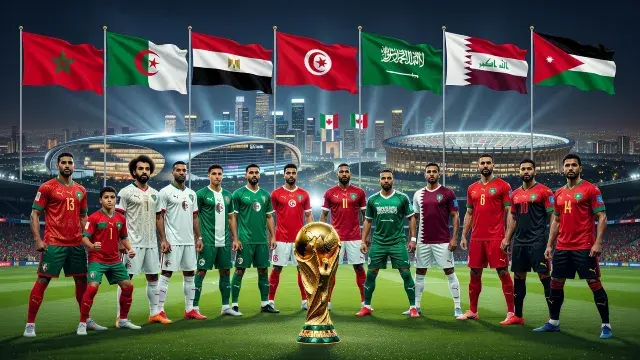
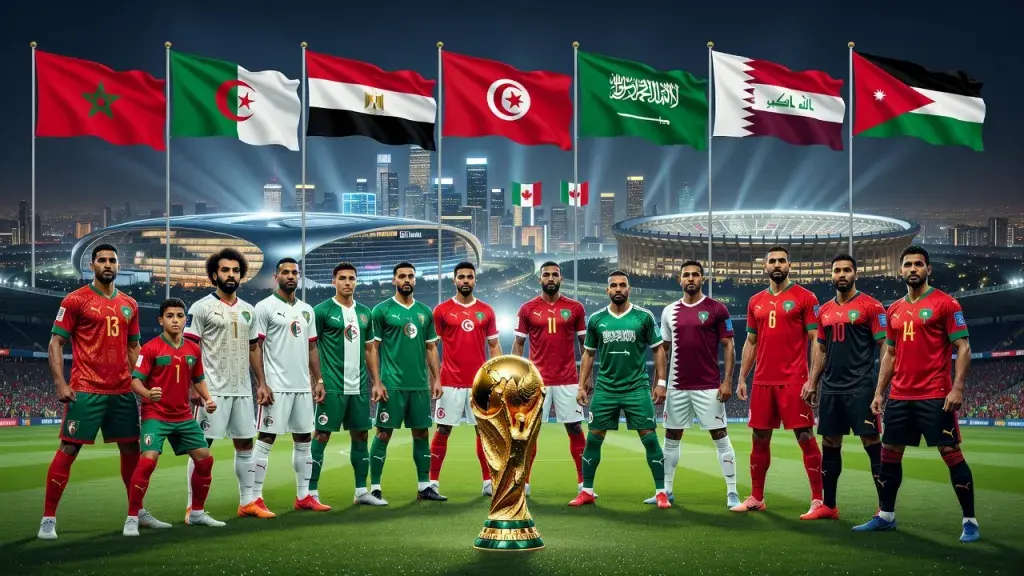
Arab football has never had a moment like this. Eight nations from the MENA region are competing at the 2026 FIFA World Cup across the United States, Mexico and Canada, the largest contingent the Arab world has ever sent to football's most important stage. The tournament's expansion from 32 to 48 teams opened additional qualifying pathways, but the presence of Algeria, Egypt, Iraq, Jordan, Morocco, Qatar, Saudi Arabia and Tunisia reflects genuine depth, not mere arithmetic fortune.
Four years on from Morocco's extraordinary run to the semi-finals in Qatar - a result that resonated far beyond the Atlas Mountains and reverberated across stadiums, living rooms and public squares from Casablanca to Baghdad - the expectation is that at least one Arab side can again go deep into the knockout rounds. The growth of the region's football ecosystem has accelerated in the intervening years, spanning club investment, league development and diaspora talent integration. Just as sports fans across the Arab world track multiple disciplines, from football to handball - with platforms dedicated to pariuri sportive handbal reflecting the broadening appetite for sport in the region - the football conversation in 2026 carries a scale and intensity that reflects a genuinely transformed landscape. Morocco lead the financial and tactical argument, but they are far from the only side with a credible story to tell.
The group-stage draw has produced wildly contrasting assignments. Morocco face Brazil in what is arguably the most headline-grabbing fixture of the entire group stage, alongside Scotland and Haiti. Qatar, the 2022 hosts, have landed in a more manageable group with Canada, Switzerland and Bosnia and Herzegovina. Algeria and Jordan share a group with defending champions Argentina and Austria, which sets up the tournament's only all-Arab head-to-head fixture and guarantees that at least one Arab team will be eliminated at the hands of another. Iraq face the steepest mountain of all, having been drawn against France, Senegal and Norway - three sides capable of advancing comfortably in most editions of this tournament.
Morocco Lead on Value, Algeria and Egypt Follow
The financial gap between the Arab nations is stark and instructive. Morocco's squad carries a combined market value of €487.2 million according to Transfermarkt - almost double that of second-placed Algeria at €256.6 million, and more than three times Egypt's €135 million. That gap reflects the depth and quality of European-based talent Walid Regragui can call upon. PSG full-back Achraf Hakimi is valued at €80 million, while teenage Lille midfielder Ayoub Bouaddi - just 18 years and eight months old - is already rated at €50 million. PSV's Ismael Saibari adds a further €40 million to the calculation.
Algeria's valuations are driven by Bayer Leverkusen's Ibrahim Maza and Manchester City's Rayan Ait-Nouri, both at €40 million, alongside Marseille forward Amine Gouiri. Egypt's figures rest heavily on two players: Eintracht Frankfurt's Omar Marmoush at €60 million and Liverpool's Mohamed Salah at €58.5 million. Tunisia, Saudi Arabia, Iraq, Qatar and Jordan complete the rankings in that order, with the Gulf sides' lower valuations reflecting their reliance on domestic-based talent rather than a lack of quality within their own leagues.
Domestic Depth Versus Diaspora Power
The contrast in squad-building philosophies across the eight nations is one of the more revealing dimensions of this Arab contingent. Morocco have 24 of their 26 players based at foreign clubs, Algeria 23 and Tunisia 20 - the North African trio have constructed squads almost entirely from the European diaspora. Saudi Arabia and Qatar have taken the opposite approach. Only one Saudi player, Lens right-back Saud Abdulhamid, is based outside the kingdom. Qatar's sole overseas representative is Homam Ahmed of Spanish fourth-tier side Cultural Leonesa. Their squads are shaped by what the Saudi Pro League and Qatar Stars League produce domestically, leagues that have attracted significant investment and, in Saudi Arabia's case, drawn major international names. The Saudi Pro League now contributes 31 players across all eight squads, including Algeria's Riyad Mahrez, Morocco goalkeeper Yassine Bounou and Egypt's Nabil Emad Donga. At club level, Al Hilal lead all sides with 12 World Cup representatives.
Salah, Mahrez and the Goalscoring Question
Mohamed Salah arrives as the Arab world's all-time leading international scorer, with 67 goals for Egypt. At 32, he enters what is almost certainly his final World Cup as the centrepiece of a squad whose average age of just over 29 makes them the oldest Arab contingent in North America. Whether Salah can finally deliver on the World Cup stage - he has two goals in previous tournaments - will define Egypt's campaign as much as any tactical consideration. Qatar's Almoez Ali follows on 60 international goals, with Hassan Al Haydos, the country's most-capped player on 185 appearances, contributing 41. Algeria captain Riyad Mahrez has 32 goals for his country, matching Iraq's all-time scorer Aymen Hussein. Salem Al Dawsari captains Saudi Arabia with 26 international goals and holds the distinction of being the highest-scoring Arab in World Cup history with three goals. Morocco's Ayoub El Kaabi, with 29 international goals, will be expected to lead the line as the Atlas Lions pursue another deep run. The region has the goals, the experience and, in several cases, the genuine quality to make noise in North America. Whether a team converts that potential into a historic result remains the defining question of Arab football's biggest-ever World Cup.