Cameron Lancaster, the former Tottenham Hotspur striker who recently retired from professional football after 253 appearances and 107 goals across a career that took him from White Hart Lane to the United States, has offered a rare and candid first-hand account of growing up alongside Harry Kane in the Spurs academy. The two forwards shared digs, training pitches, and striking partnerships from the age of 11, and Lancaster's recollections shed light on what separated a player who became England's all-time leading scorer from one whose career took a very different road.
Lancaster's story begins on his first day at Spurs, when a nervy 11-year-old from Sunday-league football found himself the target of a classmate's winding. It was Kane who stepped in to silence the teasing - a small act of decency that Lancaster says gave him immediate respect for the boy who would go on to rewrite English football's record books. The two were regularly paired together up front in a 4-4-2, scoring freely at youth level. Physically, Lancaster held the edge: quicker, stronger, more developed for his age. Kane, by his own teammates' admission, was slight and underdeveloped, sometimes deployed in midfield or floated as a potential centre-back option. The contrast in eventual outcomes, Lancaster reflects, had little to do with raw ability and everything to do with what drove each of them. Much like how the mental edge separates elite competitors across sports globally - whether in football, basketball or even pariuri baschet iran - the decisive factor at the top level is rarely talent alone, but the relentless obsession to improve.
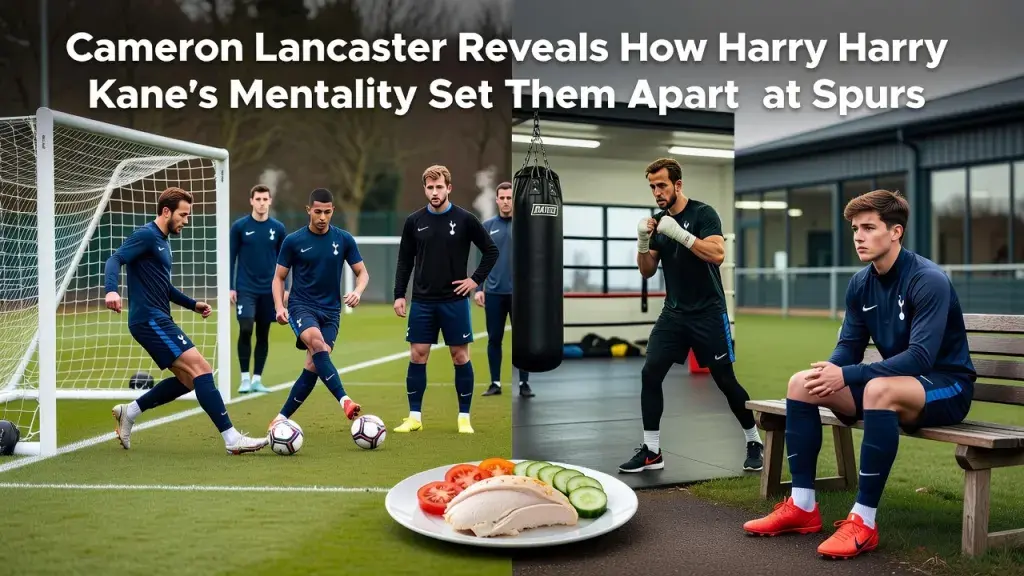
Lancaster is disarmingly honest about where he fell short. While Kane would finish training sessions practising the precise whipped finish - ball struck between instep and laces, kept low, as Les Ferdinand had preached - Lancaster was thinking about life beyond the training ground in Chigwell. Under-18 coach Alex Inglethorpe delivered the message plainly: to make it, you had to eat, breathe and sleep football. Lancaster walked away knowing, privately, that description did not fit him. Kane, on the other hand, lived it. After a body-fat assessment flagged both players, Lancaster noticed Kane's plate the next day: boiled chicken, tomatoes, cucumbers. Then Kane was in the gym boxing to burn extra calories. That was not a one-off. It was a pattern, repeated every day, across every category.
The Numbers That Told the Story
Tim Sherwood and Chris Ramsey, then part of Spurs' coaching setup, once sat Lancaster down and ran through a comparison with Kane across a list of attributes. Finishing: about the same. Speed: Lancaster. Strength: Lancaster. Heading: about the same. Then came mentality - and that was where the conversation ended. Lancaster admits the word barely registered with him at the time. It registers now. The exercise is a compelling illustration of how football development can diverge even when the physical and technical inputs look broadly similar. Scouting departments worldwide wrestle with precisely this problem: how to identify and nurture the psychological profile that turns potential into performance. Kane is, by this account, an almost textbook case of a player who bridged every gap through sheer force of will.
A Premier League Debut Before Kane - and Then the Path Divides
Lancaster did reach the top tier. At 19, a first-team striker's injury opened a door, and with manager Harry Redknapp's nod, Lancaster came off the bench against Wigan Athletic at White Hart Lane - replacing Emmanuel Adebayor with the scoreline at 3-1. He had bought new boots from Sports Direct that morning, his previous pair too battered for what he sensed was coming. He describes the roar of the crowd as he ran on as momentarily disorienting, the scale of the occasion briefly overwhelming. It remains a genuine achievement: the journey from under-12 football to the Premier League is one very few complete. Kane, who was away on loan at Millwall at the time, congratulated him warmly on returning. Lancaster did not dwell on the fact that he had made his top-flight debut ahead of his old academy partner. That competitive calculus simply was not how he was wired.
Injury, America, and an Honest Reckoning
What followed for Lancaster was a story of persistent misfortune and admirable resilience. A groin injury sustained in pre-season training cost him a year. An anterior cruciate ligament rupture in an under-23 fixture at Fulham ended his time at Spurs entirely in 2014. Trials with Orlando and Chicago, a stint at Stevenage Borough, and eventually a move to Louisville City in the third tier of American football followed - a trajectory that Lancaster describes as a bitter pill, given he had been a Premier League player just a few years earlier. He swallowed it, and it turned out to be the right call. Eleven or twelve years in the United States, a daughter, and a settled, content life are the things he would not trade. The 253 appearances and 107 goals represent a career that, even if it never matched the heights those early years hinted at, was a genuine professional one. That matters, and Lancaster knows it.
The contrast with Kane - who, at roughly the same point Lancaster was heading to Louisville, was making nearly 20 first-team appearances for Spurs, and the following season would finish as the Premier League's second-highest goalscorer while netting for England - is stark. But Lancaster draws no bitterness from it. His comparison is pointed and generous in equal measure: Tom Brady, he notes, was not the fastest or the most athletic quarterback to come out of any draft, but his mentality placed him among the greatest the sport has seen. Kane, in Lancaster's view, operates on the same frequency. The obsession with marginal gains, with body composition, with finishing technique, with precision over power - it was all visible on the training pitches of Chigwell when both of them were teenagers. Lancaster saw it clearly. He just did not share it, and he is at peace with that.
Now settled in the United States as the World Cup unfolds around him, Lancaster has half a mind to track down England's training base and walk in to say hello to his old academy partner. The tickets to watch Kane in action, he concedes, are out of reach. The friendship, if it picks up, would need no ticket at all.