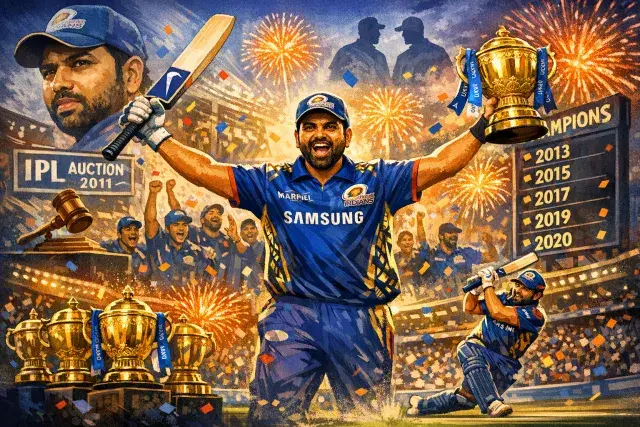
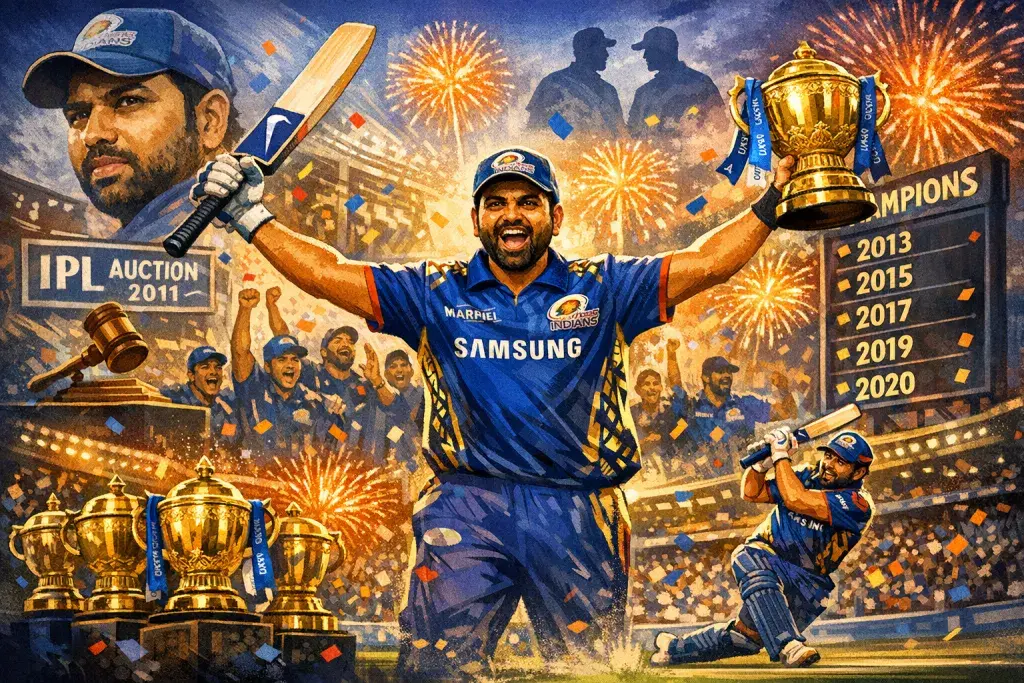
Six title wins across roughly a decade of captaincy represent the most sustained record of leadership success in the Indian Premier League's history. Rohit Sharma's tenure with Mumbai Indians — which began not as their leader but as an expensive auction acquisition in 2011 — reshaped what it means to build and sustain a dominant franchise in professional cricket. His story is as much about institutional vision and long-term commitment as it is about individual brilliance.
A Calculated Bet That Redefined a Franchise
When Mumbai Indians secured Rohit Sharma at the 2011 IPL Mega Auction for approximately 9.2 crore rupees — a figure that represented fierce competition from multiple franchises — the organisation had yet to win a single title. That was a significant financial and strategic commitment to a player who, while clearly talented, had not yet demonstrated his capacity to shape a franchise's identity. Rohit had previously been part of the Deccan Chargers setup during their title-winning run, giving him early exposure to what winning culture inside a franchise looks like. Mumbai's decision to invest so heavily, and then to eventually hand him the captaincy from the 2013 edition onward, reflected a philosophy of institutional patience that few organisations in any competitive domain are willing to exercise.
His first two years with Mumbai produced no titles. A lesser organisation might have second-guessed the investment. Instead, the franchise doubled down by giving him full leadership authority. That decision altered everything.
The Architecture of Consistent Success
Rohit Sharma's captaincy debut in 2013 produced an immediate result — a title win over Chennai Super Kings in the final. What followed was a pattern that became the defining feature of his era: Mumbai Indians won in 2013, 2015, 2017, 2019, and 2020. The consistency across those years was not accidental. It reflected a clear leadership philosophy built on squad continuity, calm decision-making under pressure, and the ability to extract collective performance from a group rather than relying on any single individual's brilliance.
The 2020 edition added historical weight to what was already a remarkable record. Mumbai entered that cycle as defending holders and successfully retained the title — only the second franchise in IPL history to accomplish that. The previous team to do so had been their most enduring rivals, Chennai Super Kings. Finishing at the top of the standings with nine wins from fourteen outings, then defeating Delhi Capitals in both the qualifying fixture and the final, underlined the structural strength of the unit Rohit had helped build. A five-wicket win in the final completed an unprecedented fifth title, establishing Mumbai as the most decorated franchise in the competition's history at that point.
Leadership Identity Beyond Results
What distinguishes Rohit Sharma's captaincy legacy from a simple accumulation of wins is the cultural imprint he left on the franchise. In professional cricket, the relationship between a leader and their organisation is often fragile — success breeds expectation, pressure reshapes decision-making, and personnel changes can disrupt carefully constructed dynamics. Rohit managed to maintain coherence across a long and evolving roster, across different formats of the competition, and across seasons that brought external pressures far beyond the boundary rope.
His record also invites a broader observation about how leadership quality compounds over time. The franchises most associated with consistent excellence in the IPL — Mumbai and Chennai — share a common thread: long-term commitment to a single, clearly identified leader. Rohit's relationship with Mumbai mirrors, in structural terms, the relationship MS Dhoni built with Chennai Super Kings. In both cases, the leader became inseparable from the franchise's identity. "Mumbai Cha Raja" — a Marathi phrase roughly translating to "King of Mumbai" — was not a marketing construct. It reflected a genuine and deeply held association between a person and a city's aspirations.
The Transition and What It Confirms
Rohit Sharma's departure from the captaincy role, with Hardik Pandya stepping in as the new leadership figure, marked the end of a specific era rather than a repudiation of what was built. Transitions of this kind are inevitable in any long-running institutional structure. The more relevant question they prompt is what the outgoing leader leaves behind — in terms of culture, expectation, and standard. Six title wins across approximately eleven years of captaincy is a record that will require sustained excellence over many future cycles to approach, let alone surpass.
Exactly fifteen years after Mumbai Indians made the decision to bring Rohit Sharma into their setup at the 2011 auction, his legacy as the defining figure in their history is settled. The franchise had no titles when he arrived. He departed as the most successful leader the competition had produced. That trajectory, from blank cabinet to six titles, represents one of the most compelling case studies in how patient institutional trust and individual leadership capacity can combine to produce something genuinely historic.