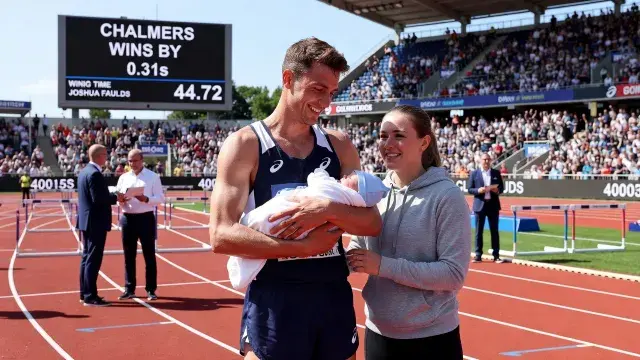
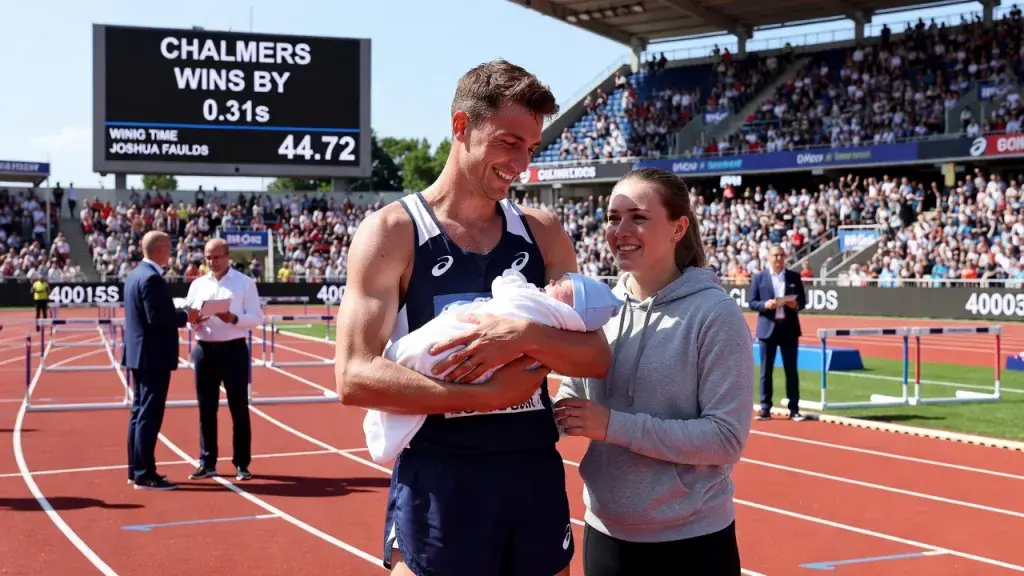
Alastair Chalmers reclaimed the British 400m hurdles title at the Alexander Stadium on Sunday, beating Joshua Faulds by 0.31 seconds in a final that carried far more emotional weight than the margin suggests. His fiancée Ellie Bell had given birth to their son Robert just four days before the opening round of competition, turning what was already a demanding championship week into one of the most remarkable of Chalmers' career. It was his sixth national crown in seven years - and almost certainly his most personal.
The Guernsey athlete was candid about how close he came to not competing at all. "I've pretty much not trained all week and my head's not really been in the game," he told BBC Radio Guernsey, in a week where even the most dedicated of competitors could be forgiven for keeping their trainers on the shelf. The Saturday heat drew a notably honest assessment - "I felt like absolute rubbish the whole way round" - and yet he returned on Sunday and delivered when it counted. Athletics, not unlike other precision disciplines tracked closely across global sports communities, rewards those who can compartmentalise under pressure; Chalmers found that switch just in time. Bell brought baby Robert trackside for the final, and after crossing the line, Chalmers held his son in an embrace that needed no commentary. It is the kind of moment that, whatever the sport - from athletics to something as niche as a bandy betting site might cover - reminds you why competition retains its grip on people across every culture and corner of the world.
Chalmers was taking back a title he had lost to Tyri Donovan twelve months ago, and his response was measured rather than triumphalist. The motivation, he made clear, was not score-settling but something simpler and deeper. "When he came up, I just couldn't lose - I had to win for him, didn't I?" That kind of galvanising force is difficult to manufacture through any training programme, and on this occasion it appeared to override the physical deficit of a week without preparation.
Commonwealth Games Ambitions Sharpened by a Strong Title Defence
The timing of the victory matters beyond the personal narrative. With the Commonwealth Games in Glasgow approaching next month, Chalmers enters the competition with momentum, a national title freshly around his neck, and a clear target in mind. He became the first track and field athlete from Guernsey to win a Commonwealth medal when he took bronze in Birmingham four years ago, and he has spoken explicitly about wanting to replicate that performance. "I've already beaten some of the top guys in the Commonwealth," he said, with the confidence of someone who has earned the right to say it rather than merely claim it.
He is also realistic about the field he faces. The 400m hurdles at Commonwealth level carries genuine depth, and Chalmers knows that individual brilliance on one day does not guarantee a podium place. "Anything can happen on the day," he acknowledged, "I've just got to make sure I'm in a good, healthy, fit position by then with more sleep and more recovery." That last clause - more sleep - carries an obvious and entirely understandable subtext for a man who became a father four days before racing at national level. The weeks ahead will be about physical restoration as much as tactical preparation.
A Career Built on Consistency From a Small Island
Six national titles in seven years is a record that speaks to sustained excellence rather than occasional brilliance. For an athlete representing Guernsey - a jurisdiction without the infrastructure or population base of the larger competing nations - what Chalmers has built is exceptional by any comparative standard. His Olympic semi-final appearance further underlines that he is not a domestic champion operating comfortably below the international waterline; he competes at the sharpest end of the event globally.
The support structure he references - "a great team and family around me" - has now grown by one. Robert Chalmers watched his father win a British title before he was a week old. Whatever comes in Glasgow, that is a story worth telling.